What Counts as a Defamatory YouTube Video? A Legal Overview

YouTube gives anyone with a camera and an internet connection the power to reach millions of people. That power cuts both ways. A single video can build a business or destroy a reputation in a matter of hours.
If someone has posted a video that names you, accuses you of something untrue, or twists facts to make you look dishonest, dangerous, or incompetent, you’re probably asking one question: is this actually defamation, or just an opinion someone is allowed to share?
The answer isn’t always simple. Defamation law was written long before video platforms existed, and courts are still working out how old legal rules apply to comments, thumbnails, titles, and algorithm-driven content. This guide breaks down exactly what makes a YouTube video legally defamatory, how the law treats creators, commenters, and platforms differently, and what your realistic options are if you’ve been targeted.
Key Takeaways
- Defamation requires a false statement of fact, not an opinion, that is published to others and damages someone’s reputation.
- YouTube videos can be defamatory through spoken narration, on-screen text, thumbnails, titles, video descriptions, or pinned comments.
- Public figures must prove “actual malice,” meaning the creator knew the statement was false or recklessly disregarded the truth.
- Section 230 of the Communications Decency Act generally shields YouTube itself from liability, but the individual creator can still be sued.
- YouTube’s Community Guidelines process is separate from a defamation lawsuit and has its own, narrower requirements.
- Screenshots, timestamps, and preserved copies of the video are essential evidence if you plan to take legal action.
What Is Defamation, Legally Speaking?
Defamation is a false statement presented as fact that harms another person’s or business’s reputation. It has two traditional forms: libel and slander.
According to the Legal Information Institute at Cornell Law School, defamation is a statement that injures a third party’s reputation, and the tort of defamation includes both libel (written statements) and slander. Video content typically falls under libel because libel is defined as a method of defamation expressed by print, writing, pictures, signs, effigies, or any communication embodied in physical form that is injurious to a person’s reputation, a definition broad enough to include recorded video, which is a fixed, reproducible medium rather than a fleeting spoken remark.
To win a defamation case, a plaintiff generally must prove four elements. Per Cornell’s Wex legal dictionary, a plaintiff must show a false statement purporting to be fact, publication or communication of that statement to a third person, fault amounting to at least negligence, and damages or some harm caused to the reputation of the person or entity who is the subject of the statement.
It’s worth repeating that last point: different states vary in their anti-defamation statutes, and courts in different states interpret defamation laws differently. There is no single, uniform “YouTube defamation law” in the United States; each state’s courts apply their own version of these four elements.
The Four Elements Applied to a YouTube Video
| Element | What It Means | Example on YouTube |
|---|---|---|
| False statement of fact | The claim must be objectively verifiable and untrue, not an opinion, joke, or exaggeration | “He was fired for embezzling company funds” (when he wasn’t) |
| Publication | The statement was shared with at least one other person | The video is uploaded publicly, unlisted, or shared privately with even one viewer |
| Fault | The creator acted negligently, or with actual malice for public figures | The creator didn’t verify a serious claim before publishing |
| Damages | The statement caused real harm | Lost job offers, canceled contracts, harassment, loss of business |
Can a YouTube Video Actually Be Considered Defamation?
Yes. Courts do not treat video content differently from newspapers, blogs, or broadcast segments simply because it appears on a platform like YouTube. What matters is the substance of what’s said and shown, not the medium.
A video can be defamatory through any of the following:
- Spoken narration, a host stating something false as fact
- On-screen text or graphics, captions, lower-thirds, or overlaid claims
- Video titles and thumbnails, a thumbnail implying guilt or wrongdoing before the video even starts
- Video descriptions, written text beneath the video
- Pinned or creator-authored comments, statements the uploader adds and endorses
This matters because many creators assume that only the “main content” of a video counts. In reality, a false and damaging claim in a thumbnail alone has been enough to support defamation claims in some cases, because thumbnails are publicly viewable statements in their own right.
Opinion vs. Fact: The Line That Decides Most Cases
The single biggest factor separating a defamatory video from a legally protected one is whether the statement is fact or opinion.
Courts consistently protect opinions, exaggeration, satire, and rhetorical hyperbole, even when they’re harsh. What they don’t protect is a statement of fact dressed up as an opinion.
Quick Comparison
| Statement Type | Protected? | Example |
|---|---|---|
| Pure opinion | Usually protected | “I think this business has terrible customer service.” |
| Fact disguised as opinion | Usually NOT protected | “In my opinion, he stole money from his clients.” |
| Verifiable factual claim | NOT protected if false | “She was convicted of fraud in 2022.” |
| Satire/parody | Usually protected | An obviously exaggerated comedy sketch with no reasonable claim to truth |
| Rhetorical hyperbole | Usually protected | “This is the worst restaurant on Earth.” |
Expert tip: The phrase “in my opinion” does not automatically protect a statement. Courts look at whether a reasonable viewer would understand the statement as an assertion of verifiable fact, regardless of the framing language used around it.
Public Figures vs. Private Individuals: Different Legal Standards
Not everyone has to meet the same burden of proof, and this is one of the most misunderstood parts of defamation law.
The U.S. Supreme Court’s landmark ruling in New York Times Co. v. Sullivan (1964) created a heightened standard for public figures. As Cornell’s Legal Information Institute explains, the Court held that proof of actual malice is required for an award of damages in an action for libel involving public officials or matters of public concern.
“Actual malice” doesn’t mean the creator hated the subject ,it means the creator either knew the statement was false or acted with reckless disregard for whether it was true.
For private individuals, the bar is lower. The Supreme Court has held that so long as they do not impose liability without fault, states may define for themselves the appropriate standard of liability for a publisher or broadcaster of defamatory falsehoods injurious to a private individual</cite>,meaning most states allow privaindividual, meaningin with a showing of simple negligence, not actual malice.
This distinction matters enormously for creators covering:
- Politicians and government officials
- Celebrities and public figures
- Company executives commenting on matters of public concern
- “Limited-purpose” public figures, people who became prominent in a specific controversy (e.g., a viral incident)
Someone who has never sought public attention, a private citizen dragged into a video because of a local dispute, a bad date, or a workplace disagreement, generally only needs to show the creator was careless with the truth, not maliciously dishonest.
Common Types of Defamatory YouTube Content
1. False Accusations of Criminal Conduct
Videos claiming someone committed theft, fraud, assault, or another crime, without factual basis ,are among the highest-risk categories, because courts often treat false accusations of criminal behavior as defamatory per se, meaning damages can be presumed without extensive proof of financial harm.
2. Fabricated Business or Professional Claims
“This doctor botched my surgery,” “this contractor scammed me,” or “this company is a pyramid scheme”when false can trigger both personal defamation and, in the case of businesses, a related claim called trade libel or product disparagement.
3. Doctored or Deceptively Edited Footage
Selectively editing real footage to create a false impression (e.g., cutting a clip to reverse its meaning) can still be defamatory, even though the underlying footage is real, because the edited version communicates a false factual impression.
4. False Statements in “Exposé” or Reaction Videos
The commentary and drama genre has grown rapidly on YouTube, and with it, a wave of “callout” videos. These videos are not automatically protected just because they’re framed as commentary if they assert unverified facts about a real person, they carry the same legal risk as any other content.
5. Impersonation or Fabricated Quotes
Putting words in someone’s mouth via voiceover, AI-generated audio, or misleading captions can constitute defamation if viewers reasonably believe the person actually said or did what’s shown.
Step-by-Step: What to Do If You Believe a YouTube Video Is Defamatory
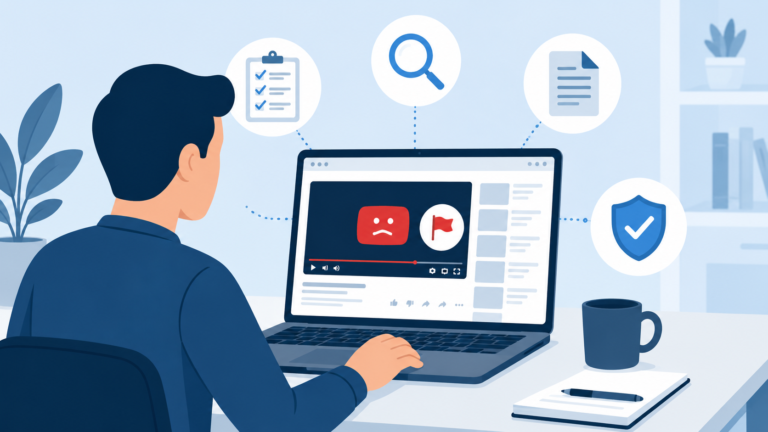
- Preserve the evidence immediately. Screen-record the video, capture the URL, note the timestamp of the defamatory statement, and save the video description, comments, and thumbnail. Videos can be edited or deleted, and preserved evidence is critical.
- Determine whether the statement is fact or opinion. Reread the earlier comparison table. If it’s clearly framed as a joke, exaggeration, or personal opinion with no factual claim, a lawsuit is unlikely to succeed.
- Assess your status as a public or private figure. This determines whether you’ll need to prove actual malice or simple negligence.
- Document actual harm. Lost clients, canceled job offers, harassment, or measurable reputational damage strengthens a claim considerably.
- Send a cease-and-desist or retraction demand. Many creators will remove or edit a video once formally notified of a legal claim, especially if presented with specific, factual inaccuracies.
- Report the video through YouTube’s internal policies. This is separate from a lawsuit and often faster.
- Consult an attorney before filing suit. Defamation law varies by state, and a lawyer can evaluate whether your specific facts meet your state’s legal threshold.
If you’d like a deeper breakdown of the warning signs before you get to this stage, learn how to spot defamation on YouTube so you can act quickly and preserve your legal options.
How YouTube’s Own Policies Handle Defamation
YouTube’s Community Guidelines process is not a legal proceeding, it’s a private platform policy, and it works differently from a courtroom.
According to YouTube’s own Help Center on harassment and cyberbullying, the platform prohibits content that contains prolonged insults or slurs based on someone’s intrinsic attributes, including protected group status, physical attributes, or status as a survivor of sexual assault, non-consensual intimate imagery distribution, domestic abuse, child abuse, and more. Importantly, these policies apply to videos, video descriptions, comments, live streams, and any other YouTube product or feature.
However, YouTube’s process for handling defamation specifically is narrower than its general harassment policy. Legal guidance on the removal process notes that before taking action, individuals should carefully evaluate the video, since videos may be eligible for removal if they contain harassment and cyberbullying, threats, doxxing, or other policy violations. In practice, this means a formal legal defamation complaint and a Community Guidelines report often need to be pursued as two separate tracks.
According to a safety guide referencing YouTube’s practices, YouTube only considers defamation reports submitted by the party in question or their authorized legal representative, though bystanders can still report violations of YouTube’s Community and Privacy Guidelines through the general reporting tools.
Once a report is filed, YouTube’s moderation team reviews the flagged content, and per legal industry guidance, if the video violates Community Guidelines, YouTube typically removes it within a few days.
YouTube Reporting vs. Legal Defamation Claim
| YouTube Community Guidelines Report | Formal Defamation Lawsuit | |
|---|---|---|
| Who can file | Often limited to the affected party or their legal representative for defamation-specific reports | Only the harmed party (plaintiff) or their attorney |
| Standard applied | YouTube’s internal policy language | State defamation law (the four legal elements) |
| Speed | Can take days | Can take months or years |
| Outcome | Video/content removed if it violates policy | Money damages, injunctions, retractions |
| Cost | Free | Attorney fees, court costs |
Why YouTube Itself Is Rarely the One Sued
Many people assume they can sue YouTube directly for hosting a defamatory video. In almost all cases, this doesn’t work because of Section 230 of the Communications Decency Act, a federal law that generally protects online platforms from liability for content posted by their users.
This is why most defamation claims target the individual creator who made the statements, not the platform that merely hosts the video. Section 230 does not, however, protect the person who actually created and uploaded the defamatory content; their personal liability remains fully intact.
Statute of Limitations: You Don’t Have Unlimited Time
Every state imposes a statute of limitations, a deadline for filing a defamation lawsuit, typically ranging from one to three years from the date of publication, depending on the state. Waiting too long, even while gathering evidence, can permanently bar your claim. This is one of the most important reasons to consult an attorney early rather than waiting to “see if it blows over.”
Common Mistakes People Make When Dealing with Defamatory Videos
- Assuming any negative video is automatically defamation. Harsh criticism, satire, and honest negative reviews are legally protected.
- Waiting too long to preserve evidence. Videos get edited, re-uploaded, or deleted, and screenshots without timestamps carry less evidentiary weight.
- Publicly confronting the creator before consulting a lawyer. Public arguments can escalate the situation and sometimes generate more content, not less.
- Ignoring the difference between a platform report and a lawsuit. Filing only a YouTube report, without legal follow-up, leaves no path to damages if the harm is significant.
- Missing the statute of limitations while trying to negotiate informally.
- Not documenting actual financial or reputational harm, which weakens an otherwise valid claim.
Best Practices If You’re a Creator (To Avoid Being Sued)
- Verify serious factual claims with documentation before publishing, especially accusations of crime or professional misconduct.
- Clearly frame subjective commentary as opinion, and avoid stating unverified claims as settled fact.
- Be cautious with thumbnails and titles, they are standalone statements that can be evaluated independently of the video’s content.
- Retain your sources, screenshots, and research in case you need to defend a claim’s accuracy later.
- When covering private individuals (not public figures), apply extra caution, since the legal bar for a successful claim against you is lower.
- Issue prompt corrections if you discover an error, since timely retractions can reduce damages in many states.
When to Seek Professional Help
If a video has caused real, measurable harm,lost income, canceled contracts, harassment, or damage to your professional standing, informal reporting alone is often not enough. An attorney or a specialized reputation management service can evaluate the specific statements, your jurisdiction’s legal standard, and the strongest path to removal, whether that’s a formal cease-and-desist, a platform escalation, or litigation.
If you’re dealing with a video like this right now, you can get professional content removal services for defamatory YouTube videos to have the situation evaluated by people who handle these cases regularly.
Conclusion
Not every unflattering YouTube video is defamation but not every defamatory video is harmless “opinion” either. The difference comes down to whether a false statement of fact was published, whether the creator acted negligently or maliciously, and whether real harm resulted.
If you believe you’ve been targeted, the smartest first moves are the same every time: preserve the evidence, assess whether the statement is fact or opinion, understand your status as a public or private figure, and get qualified legal guidance before the clock runs out on your state’s statute of limitations. Acting quickly and correctly gives you the best chance of protecting your name and, where appropriate, holding the creator accountable.
Frequently Asked Questions
1. Can I sue someone for making a YouTube video about me? You can only sue successfully if the video contains a false statement of fact (not opinion) that was published and caused you real harm, and the creator acted with at least negligence (or actual malice, if you’re a public figure).
2. Is criticism in a YouTube video considered defamation? No. Honest criticism, negative reviews, and opinions even harsh ones are generally protected speech, as long as they don’t assert false facts.
3. Can a video thumbnail alone be defamatory? Yes. A thumbnail is a standalone published statement. If it falsely implies something factual and damaging (for example, implying guilt of a crime), it can support a defamation claim independent of the video’s actual content.
4. Does YouTube remove defamatory videos automatically? No. YouTube reviews reports manually, and its defamation-specific process typically requires the affected individual (or their legal representative) to submit the complaint directly rather than relying on general community reports.
5. Can I sue YouTube itself for hosting a defamatory video? Generally, no. Section 230 of the Communications Decency Act shields platforms like YouTube from liability for content posted by users; claims are typically brought against the individual creator instead.
6. What’s the difference between libel and slander on YouTube? Slander traditionally refers to spoken statements, while libel covers written or fixed content. Because YouTube videos are recorded and reproducible, courts generally treat defamatory statements in videos as libel.
7. How long do I have to file a defamation lawsuit over a video? It depends on your state’s statute of limitations, which commonly ranges from one to three years from the date the video was published. Consult a local attorney to confirm the deadline that applies to you.
8. Do I need to be a public figure for a claim to succeed? No, you don’t need to be a public figure. In fact, private individuals generally have an easier path to a successful claim, since many states only require proof of negligence rather than actual malice.
9. What if the video is satire or clearly a joke? Satire and parody are generally protected, provided a reasonable viewer would understand the content isn’t asserting literal facts. Context, tone, and audience reaction are all factors courts consider.
10. What evidence should I gather before contacting a lawyer? Save the video URL, a full screen recording, timestamps of the defamatory statements, the video description, thumbnail, relevant comments, and any documentation of harm you’ve experienced (lost business, job offers rescinded, harassment messages, etc.).